Friday, December 18, 2009

Water, Water Everywhere!


It's been very quiet in the garden for the past three weeks... because I cannot get there! After three years of official drought and one year that was "normal" rainfall-wise, 2009 has decided to be a wet year here in Central Virginia. I can't tell you how much we have gotten in the past three weeks - because I cannot walk into the yard (seriously!) to see the rain gauge. In November we had 8 inches before we left for Thanksgiving.

It rained while we were gone, but I was able to cut the front yard (which slopes more, so had more runoff), but I still cannot cut the back. In fact, we have had so much rain that water is still standing - after three, count them, three weeks. We have gone to the shed a couple of times where there was just no other choice, but we have left little foot sized ponds with every step! Every time it almost dries out, we get more rain. Tonight we are supposed to get freezing rain and snow. Normally snow is a good thing (for the garden) because it melts slowly and the ground is able to absorb a bigger percentage (not much runoff), but I am guessing that we are wet all the way thru the good dirt and down to the clay, so now I am worried about root rot!

Most plants can go two to three weeks without watering - they look pretty bad, but they sacrifice their leaves to save their structure and with a bit of water come right back. But wet ground is a "whole nuther" thing. Plants can only stand in water so long before they, too, drown. They need oxygen exchange in their roots and if the ground is just too wet, they cannot get it. The danger in my garden is exactly that. I have built up about eight inches of good rich humusy growing dirt over the native clay. Normally water fills in that eight inches of good dirt and then evaporates off. In these conditions it can't evaporate enough and the water may be standing underground on top of that clay causing root rot. Unfortunately, I won't know until spring.

So, all I can do is hope for sunshine soon and hope that most things have sufficient root structure to hold them thru this "crisis". So all of the photos are from prettier days! The one day I was able to get out to check on the pond, frogger was still there, so thought you might like to meet him. He still looks the same, only larger! Must have been a good summer for bugs.

Sunday, December 6, 2009

Guest Garden - Even in Winter

As the first [very] light snow hit Central Virginia yesterday, I needed to think of warmer places and one of my favorites is Hilton Head Island, South Carolina. We have been spending Thanksgiving there for the past ten or so years. Some years we get balmy 70's and some years it's not quite so nice, but usually warmer and sunnier than here.

This year we were not lucky. A low pressure cell was hanging just out to sea, and the entire mid-Atlantic coast - even as far south as South Carolina - was cool and rainy. We had good enough weather to play tennis every morning, but never set foot on the beach - not even to walk - because it just wasn't nice enough. However, in visiting all our favorite places on the island, we found a new one - the Compass Rose park.

Apparently the original development company for the island was named Compass Rose, and this new "green space" is named in honor of that founding presence. [See logo design above.] We saw the park under construction last fall and it will be several years before the vegetation is mature and full-sized, but it has interesting bones and will be lovely in a couple of years - and on a sunny day!!

The park is an interesting blend of hard scape and water features (ponds, falls, bubblers and sprinklers with wide walkways that are easily accessible to handicapped individuals) and areas planted with native plants. In late November there was little in bloom, but one can easily see how pretty it will be "in season" and how easy to maintain it is.

The water features are filled with taro, dwarf papyrus and pickerel rush. I was a bit surprised not to see lotus or water lilies, but they may have chosen plants with less summer spread, since they have such a long growing season. There is also an interesting blend of natural beds with the very "constructed" waterways that are concrete and stone and all very "straight-lined". When it's mature I think the plants will soften the harsh edges in a very nice way and create a neat contrast.

As you can see, the main thing blooming right now is pansies. [What would we do in the south without our pansies for color in the late fall and early spring?] I did find one azalea with a few blooms and one day lily what clearly had lost track of the seasons, but otherwise, it was purple and white pansies. But look at all that white concrete wall and all that water and imagine first hawthorn and then azaleas in bloom next spring - gorgeous!


*****

There is one other Hilton Head sight that I want to share with you. Like other places in the deep south decorating for Christmas creates a fun juxtaposition. Many of the developments had not started their decorating yet, so I had to look for a place to take this photo to share with you. How can you not love blooming spring flowers (see the pink begonias in the foreground and the dusty miller in the middle) and the ribboned Christmas garland? By now many of the entrances have added lights, wreathes and candles - wish I were there to see it!

Tuesday, December 1, 2009

Winter's First Kiss

The chilly kiss of winter finally touched the garden last night - about two weeks later than usual. We normally have our first heavy frost around the middle of November, but even with the recent cooler temperatures and rainy days, the real cold has held off for a while this year. Early this morning I found frosty grass and pansies with white-painted edges for the first time. The last tomatoes and the mandevilla are definitely gone now.

But there are other blooms still holding their own. We were gone last week and returned to find even more blooms on the sassanquas and two surprises - one of the hydrangeas put out a small, but pretty mophead, and my miniature white rose has bloomed one last time. Both are special plants: mother gave us the hydrangea our first Christmas in this house, and the rose came from my Aunt Agnes' garden. I consider it my inheritance from her.

There's still lots of fall deadheading left to do, and I am falling behind. The obstacle, tho, is wet ground. Two weeks ago we got 5.5 inches of rain and last week at least 3 more, so the ground is sodden. It's so wet that we are walking around the outside edges as best we can to avoid creating "holes" by stepping into the wet, wet ground. I cut the grass in the front and on the side on Sunday, but couldn't even try to cut the back yard because of the standing water in some places.

When I can get back outside to work - after a couple of days of sun and hopefully a bit more warmth - I should be able to catch up in a couple of afternoons. Meanwhile, I am enjoying just looking at the changes. All the leaves are down and the structure of the trees and larger shrubs is showing. The evergreens have come into their own as their deciduous friends have shed their leaves and color.

There's a peace about the winter garden, that's due in part to its emptiness. In two more weeks all signs of the summer abundance of bloom will be gone and we will do the holiday decorating with greenery and berries. After that we'll have the real cold - maybe even some snow. Then the solitary stars of the garden will begin doing their thing. In just six weeks there will be a few camellias, followed by the hellebores, and then the earliest bulbs. Heck, spring is almost on its way!

Sunday, November 22, 2009

The Last Little Project of the Fall

A ton of rain fell ten days ago (seriously, more than 6 inches in three days) and left the yard and garden a sodden mess. The only walking we did across the yard for the next three days was to feed the fish! But once it dried out a good bit, I was able to dive into the one remaining fall project - making a new bed for the nandina hedge at the back of the lot. Our back boundary is partly fenced, partly filled with a euonomous hedge and partly open. About 18 months ago I started moving volunteers of Nandina domestica into a line (or sorts) to start completing the existing hedge with nandinas. We already have nandinas around the front porch and they produce a lot of volunteers so it was the perfect way to thin the existing growth and at the same time provide plants for a new area.

In order to control the grass and provide a better growing situation I took edging and laid out a bed around the plants that I had already planted. But here's where my problem began. There are many types of edging one can use in the garden and I made a bad choice. Well, at least I installed it poorly. I used a plastic edging that came in six-inch pieces that are pointed on one edge. You pound them into the ground and then hook the next one in as you pound it. The problem was that I did not keep them straight. The resulting bed was a double S-curve. It was difficult to cut the grass beside it, and it looked stupid!

So, my final project of the fall was to pull out the old edging and replace it with a new straight edging. After all that rain the ground was softer than normal, so last Saturday I dove in. I had previously done the homework: measured the length of the bed (20 feet long) and calculated how many feet of material I would need. And I bought the material several weeks ago. This time I chose a steel edging that comes in 8-foot lengths which interlock and are stabilized by driving spikes thru tabs built into the strips. In order to install this edging you must either have soft enough ground to drive it down, or you have to cut a slit for it. With the softer ground, there were only a couple of places that I had to cut a slit with my root knife and those places were where I was going thru heavy grass and having to cut the roots out.

First, I laid out a straight line. Using two iron bars that I drove into the ground at each end of the proposed bed, I ran a rope line and used it to keep my edging straight. Now, if it were my father-in-law doing this project, the edging would have been measured up and down and sideways. For purposes of my boundary, I did not feel the need to do that. I simply used the line to keep the steel strips "mostly straight" over the eight-foot run. The final result is that the bed looks fine, because no one can see the small deviations that exist. The only hard part of this whole project was turning the corners. The steel is bendable, but it's hard to do. I could have enlisted help and used a vice to make exactly straight square corners, but my bed is not that formal and I preferred a softer, rounder corner; so I simply measured where to bend it and then stood on the strip and pulled it up until it was bent about 90 degrees. I have previously used this type of educing and found that if I hammered directly on the edge, some of the epoxy coating chipped off, so this time I placed a board over the edge and hammered on the board. For the corners, I put the board diagonally across the corner so that I could sink the two sides at the same time, and more evenly. I started on the "back" side of the bed - the side that abutts the neighboring property. I wanted this side to be the most straight and look the best - just as one puts the "pretty" side of the fence facing the neighbors.

There was one final problem, of course. I was about 18 inches short on material. It comes in a number of short pieces, as well as the 8-foot lengths, but nothing that really fit well with what I was doing, so I did not close the rectangle on the final side. Instead I used a couple of the old plastic pieces from the former edging. The result is fine and no one will really notice - if I don't point it out to them.

This new bed is slightly wider than the old bed and because it's straight, it now includes some areas that were previously planted in grass, so the next-to-final step was to stray the grass and weeds that are now inside the bed. As soon as they die, I will do one final weeding and put in some mulch for the winter. So now it's Mother Nature's turn. I have straightened out the bed and will have a good mulch done next weekend, so now I need the shrubs to grow.

[A couple of notes:

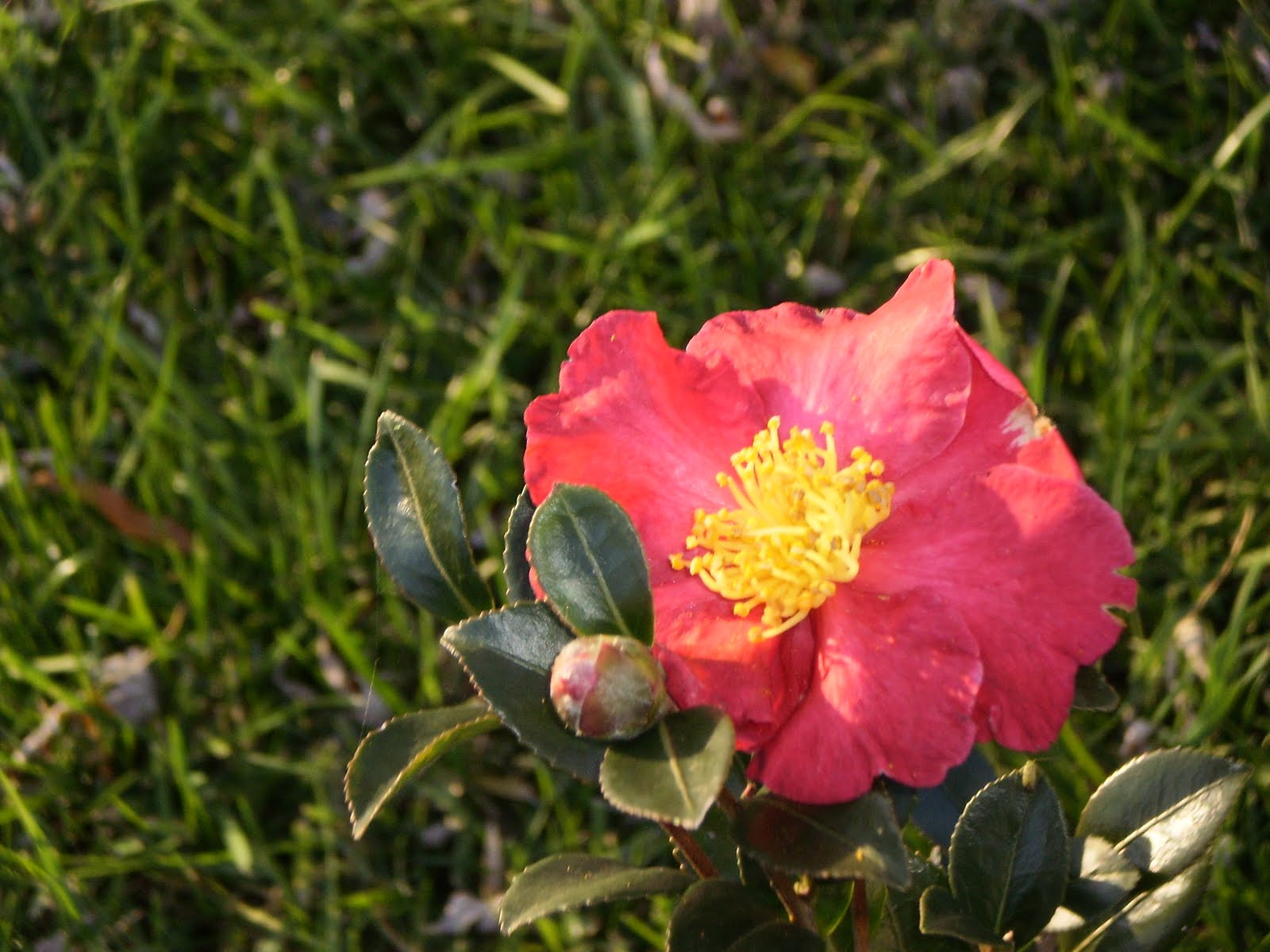
First, the gorgeous flowers at the top of the post are Camellia sassanqua. Altho I am not sure of the variety, I think it's 'Merry Christmas'. This is a member of the camellia family that blooms a bit earlier in the year than the "regular" camillias. My sister-in-law gave me two last year for Christmas, so this is their first time to bloom in the ground. They are covered with buds and if we don't have a long and really cold spell of weather, they will bloom thru Christmas and maybe into January. My "regular"camillia doesn't normally bloom until the week before Christmas and by then if it often frost damaged. These blooms are particularly pretty with the bright yellow stamins. I was thrilled when it popped into bloom the middle of November.

I am planning a series of posts during the dead of winter on various how-to gardening topics. How to choose the right edging for your location will be one of them. ]